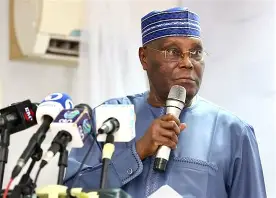
Adum Hails Atiku’s Subsidy Plan as Sound Economics, Not Populism
Abuja, August 22, 2026 — Former Benue State Attorney-General and Commissioner for Justice, Dr. Alex Adum, has strongly defended former Vice President Atiku Abubakar’s proposed fuel subsidy framework, describing it as the product of genuine economic reasoning rather than political populism.
Speaking in an interview on ARISE News, Adum argued that Atiku’s policy pronouncements demonstrate the thinking of someone who continues to study and apply economic principles.
He specifically referenced the Latin phrase *ceteris paribus*—“all other things being equal”—to explain why subsidy decisions must always be judged against prevailing conditions.
Context of Past Subsidy Removal
Adum recalled that when Atiku served as Chairman of the National Economic Council, one of the central justifications for removing subsidy was Nigeria’s complete lack of functional public refining capacity.
All government-owned refineries were shut down at the time.
Policies that made sense under those circumstances, he said, cannot be applied rigidly when conditions have changed.
From Import Subsidy to Production Support
According to Adum, Atiku is not proposing a return to the old, opaque import-based subsidy regime that was widely criticized for encouraging corruption and arbitrage.
Instead, the former vice president wants to relocate government support to the production and refining stage.
“I think Atiku’s policy pronouncements are based on the fact of someone who is reading and studying economics even in old age,” Adum said. “Atiku is saying, ‘Look, I am going to move away from import subsidy — which is where the distortions are located—to domestic production and refining subsidy.’”
Under the proposal, qualifying local refineries would receive crude oil at preferential or discounted rates.
This, Adum explained, would allow them to refine petrol more cheaply and supply the domestic market at lower prices than imported fuel.
The support would be targeted, capped, budgeted, time-bound, and independently audited, with the subsidy “following the barrel” rather than disappearing into a web of middlemen.
Why Location of Subsidy Matters
Adum stressed that the point at which subsidy is applied determines whether it is transparent or open to abuse. Subsidising imports, he noted, involves too many actors and creates opacity.
Directing support to a limited number of domestic refiners, by contrast, makes monitoring easier and ensures the benefit reaches producers who can actually lower pump prices for ordinary Nigerians.
“When you locate the subsidy where it is strongest, which is at the refining link, not at the consumption or importation link, you are going to have petrol produced cheaper than imported petrol,” he concluded.
Broader Political Context
Atiku, the African Democratic Congress (ADC) presidential candidate for 2027, has framed the proposal as a disciplined production-support mechanism designed to accelerate domestic refining capacity while easing the cost-of-living burden on citizens.
The idea has drawn sharp criticism from the Presidency and supporters of President Bola Tinubu, who have labelled any talk of restoring subsidy elements as economic ignorance.
Atiku’s camp has responded by accusing the current administration of removing the subsidy without adequate safeguards and without transparent accounting of the purported savings.
Adum’s intervention adds a legal and policy voice to the intensifying debate over energy pricing, refining capacity and the economic direction Nigeria should take ahead of the 2027 general elections.
Whether the production-based model can be designed and implemented without recreating old leakages remains a key question that both supporters and critics will continue to probe.
 politics
 Adebayo Challenges Tinubu: Where Is Subsidy Money? Come Out and Account for It
 politics
 NDC Wins Logo Battle as Abuja Court Orders INEC to Use Modified Design
news Atiku Exposes Tinubu’s FAAC Scam: Bigger Naira, Poorer Nigerians
 news
news Police Arrest Hafsat Abubakar Over Fake Fintech Shutdown Document Circulated Online
 politics
 Sowore Declares Peter Obi Yelwata Blockade Government-Sponsored Political Attack
How do you feel about this news?
Community Additions
Have a news tip, correction, or extra context about this story? Post it below instantly. All submissions appear live on this screen immediately.