Nigerian Troops Smash ISWAP Roadblock, Free 53 Civilians in Borno
Borno, Nigeria - In a bold and decisive operation that underscores ongoing efforts to restore security in Nigeria’s troubled Northeast, troops of Operation HADIN KAI have dismantled a suspected ISWAP/JAS terrorist roadblock along the Buratai–Kamuya road in Biu Local Government Area of Borno State, rescuing 53 civilians and recovering eight vehicles.
The operation, carried out by the Joint Task Force (North East), reflects the military’s sustained pressure on insurgent networks that continue to prey on vulnerable communities and disrupt daily life in the region.
According to reports, the troops moved swiftly to neutralize the illegal checkpoint, which had been used by terrorists to extort, abduct, and terrorize travelers on a key route.
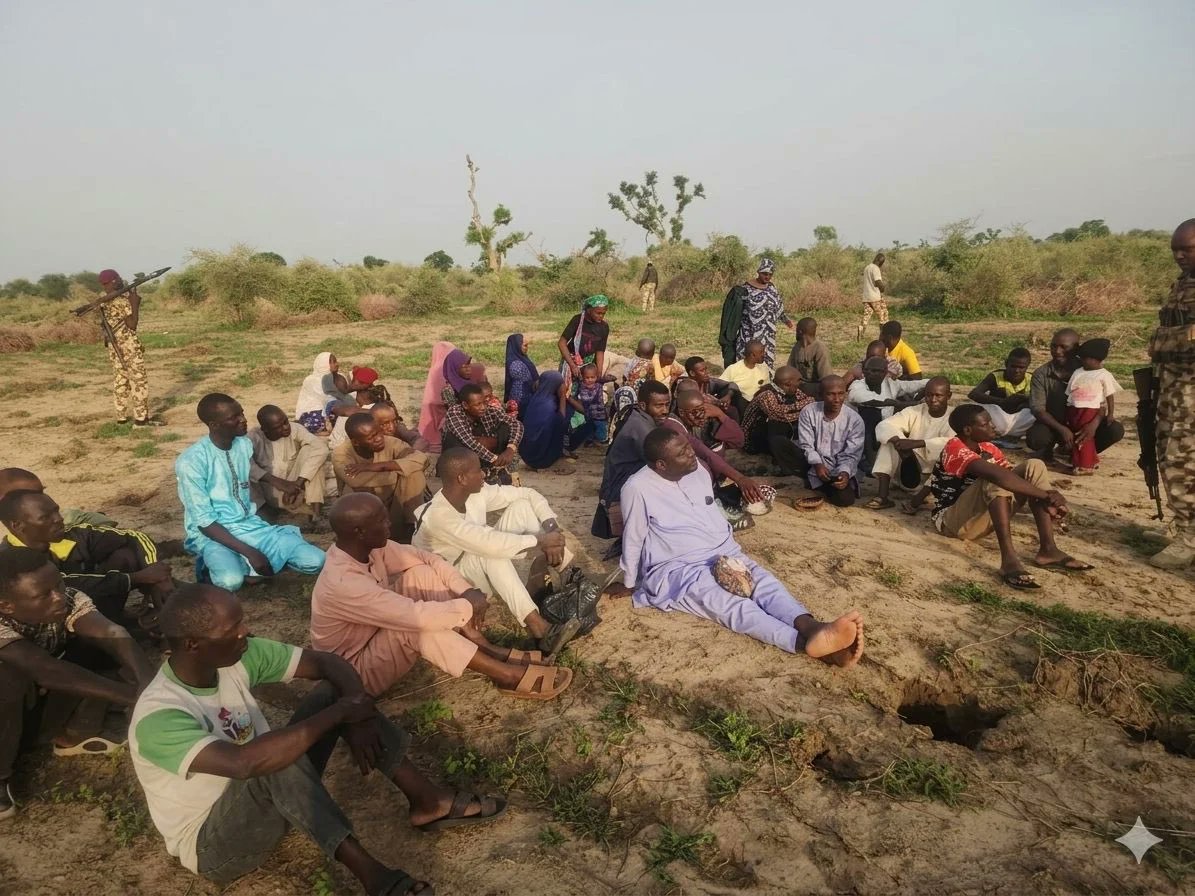
Images from the scene show dozens of relieved men, women, and children—many appearing exhausted but visibly safe—gathered under military watch in an open, arid landscape.
Soldiers stand guard as the rescued civilians sit or rest on the sandy ground, a poignant reminder of the human cost of the protracted insurgency that has plagued Borno and surrounding states for over 15 years.
For these 53 individuals, the intervention likely meant the difference between freedom and prolonged captivity, forced labor, or worse. Families separated by fear on the roads can now begin the process of reunion, though the psychological scars of such encounters often linger long after the immediate danger passes.
Borno State remains a focal point of the Boko Haram and ISWAP (Islamic State West Africa Province, also referred to as JAS) insurgency.
Despite significant territorial gains by Nigerian forces in recent years, splinter groups and remnants continue to mount asymmetric attacks, including roadblocks, ambushes, and abductions aimed at civilians and soft targets.
This latest success comes amid a pattern of proactive operations by Operation HADIN KAI.
In recent weeks and months, the force has conducted multiple rescues, including over 47 captives (mostly women and children) from ISWAP hideouts in the Lake Chad region and earlier operations foiling mass abductions ahead of holidays.
Military spokespersons have emphasized that such actions are part of a broader strategy combining ground offensives, intelligence-driven raids, and air support to degrade terrorist capabilities and create safer corridors for communities.
Reactions on social media have been largely positive, with many Nigerians commending the troops for their bravery and quick response.
“A commendable operation,” one user noted, highlighting the importance of sustained security for the region’s recovery.
Others expressed hope that these tactical victories translate into lasting peace.
Yet, not all voices are uniformly optimistic. Some residents and observers point to the recurring nature of such incidents as evidence that more comprehensive measures—improved intelligence, community engagement, economic opportunities in affected areas, and better protection of major roads—are needed to prevent terrorists from regrouping.
As one commentator observed in replies to the news, “Success shouldn’t only be measured by rescue operations, but by how permanently these roads are secured.”
The Nigerian Army’s Operation HADIN KAI continues to bear the brunt of this fight, often in harsh terrain far from public view.
Their efforts deserve recognition, even as the nation grapples with the deeper roots of insurgency—poverty, ideological extremism, governance gaps, and the human toll on both soldiers and civilians.
The rescued individuals are receiving necessary support, and authorities will likely work to reunite them with families while intelligence teams exploit any leads from the dismantled roadblock.
This operation is not the end of the story in Borno, but it is a powerful chapter—one that reaffirms the military’s commitment and offers a glimmer of hope to communities yearning for normalcy.
As Nigeria pushes forward, balancing kinetic operations with holistic stabilization efforts will remain critical to turning tactical wins into enduring peace.
The road to normalcy in the Northeast is long, but days like today remind us that progress, however incremental, is possible.
 politics
 Adebayo Challenges Tinubu: Where Is Subsidy Money? Come Out and Account for It
 politics
 NDC Wins Logo Battle as Abuja Court Orders INEC to Use Modified Design
 news
news Atiku Exposes Tinubu’s FAAC Scam: Bigger Naira, Poorer Nigerians
 news
news Police Arrest Hafsat Abubakar Over Fake Fintech Shutdown Document Circulated Online
 politics
 Sowore Declares Peter Obi Yelwata Blockade Government-Sponsored Political Attack
How do you feel about this news?
Community Additions
Have a news tip, correction, or extra context about this story? Post it below instantly. All submissions appear live on this screen immediately.