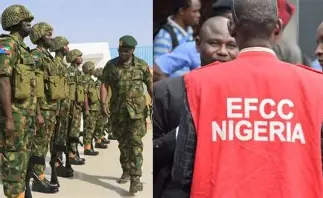
EFCC, Nigerian Army Forge Stronger Alliance in Anti-Graft Fight
LAGOS, Nigeria — In a significant move underscoring Nigeria’s multi-agency approach to tackling economic and financial crimes, the Economic and Financial Crimes Commission (EFCC) and the 81 Division of the Nigerian Army have reaffirmed their commitment to enhanced strategic collaboration, intelligence sharing, and operational synergy.
The partnership, described by officials as essential in the face of evolving threats, was highlighted during a high-level courtesy visit on Thursday, June 18, 2026.
Assistant Commander of the EFCC (ACE I) Adebayo Adeniyi, Acting Zonal Director of the EFCC’s Lagos Zonal Directorate 1, led a delegation to the headquarters of the 81 Division in Lagos, where they met with Major General Adebayo Abdulrahman Babalola, the General Officer Commanding (GOC).
A Culture of Institutionalized Cooperation
Speaking at the meeting, Adeniyi emphasized the need to institutionalize such inter-agency ties.
“Strategic collaboration and synergy among security and law enforcement agencies must be sustained as a culture,” he stated, pointing to the dynamic and sophisticated nature of modern economic crimes and broader national security challenges.
This visit builds on Adeniyi’s established pattern of outreach. As acting zonal director, he has actively pursued partnerships with other entities, including the Nigeria Customs Service and banking compliance officers, to strengthen the frontlines against corruption.
Major General Babalola, who assumed command of the 81 Division earlier in 2026 as its 26th GOC, has focused on bolstering security in Lagos and Ogun States through local collaborations.
His leadership emphasizes discipline, professionalism, and joint efforts against threats ranging from financial crimes to broader instability.
Why This Partnership Matters: Context and Implications
Nigeria’s battle against economic and financial crimes is multifaceted. The EFCC, as the country’s premier anti-graft agency, investigates and prosecutes cases involving fraud, money laundering, and public fund mismanagement.
The military, particularly divisions like the 81st in the economic hub of Lagos, brings intelligence capabilities, logistical support, and a mandate to protect national security—areas where overlaps with economic threats, such as terrorism financing or large-scale fraud, are increasingly evident.
Nuances and Broader Picture: Past collaborations between the EFCC and the Army have targeted issues like terror financing in the South-East and financial crimes in Edo State.
These joint efforts often yield better results through shared intelligence, but challenges remain, including bureaucratic hurdles, resource constraints, and the need for sustained trust across agencies.
Critics sometimes question the depth of such partnerships, wondering if they translate into tangible convictions or merely symbolic gestures.
However, in an era of sophisticated cyber fraud, cryptocurrency-enabled laundering, and cross-border schemes, institutionalized synergy is no longer optional—it’s a strategic necessity.
Edge cases, such as military personnel potentially involved in graft or overlapping jurisdictions, require clear protocols to avoid conflicts.
Human Impact: For ordinary Nigerians, stronger collaboration could mean fewer high-profile scams draining public resources, reduced vulnerability to fraud rings preying on citizens, and a more secure environment for business and investment.
In Lagos, a commercial nerve center, disruptions to economic crimes directly affect livelihoods, from small traders to multinational operations.
Visuals from the Engagement
The EFCC’s announcement featured a compelling image of Adeniyi and Babalola shaking hands, overlaid with meeting scenes, symbolizing unity in purpose.
This development comes amid the EFCC’s ongoing operations nationwide, including recent arrests of internet fraudsters and high-profile probes, signaling an active front in the anti-corruption war.
As Nigeria grapples with economic pressures and security concerns, initiatives like this offer a measured note of optimism: when key institutions align, the odds against graft and related threats improve.
Stakeholders will watch closely to see how this reaffirmed commitment translates into concrete actions and results in the months ahead.
 politics
 Adebayo Challenges Tinubu: Where Is Subsidy Money? Come Out and Account for It
 politics
 NDC Wins Logo Battle as Abuja Court Orders INEC to Use Modified Design
 news
news Atiku Exposes Tinubu’s FAAC Scam: Bigger Naira, Poorer Nigerians
 news
news Police Arrest Hafsat Abubakar Over Fake Fintech Shutdown Document Circulated Online
 politics
 Sowore Declares Peter Obi Yelwata Blockade Government-Sponsored Political Attack
How do you feel about this news?
Community Additions
Have a news tip, correction, or extra context about this story? Post it below instantly. All submissions appear live on this screen immediately.