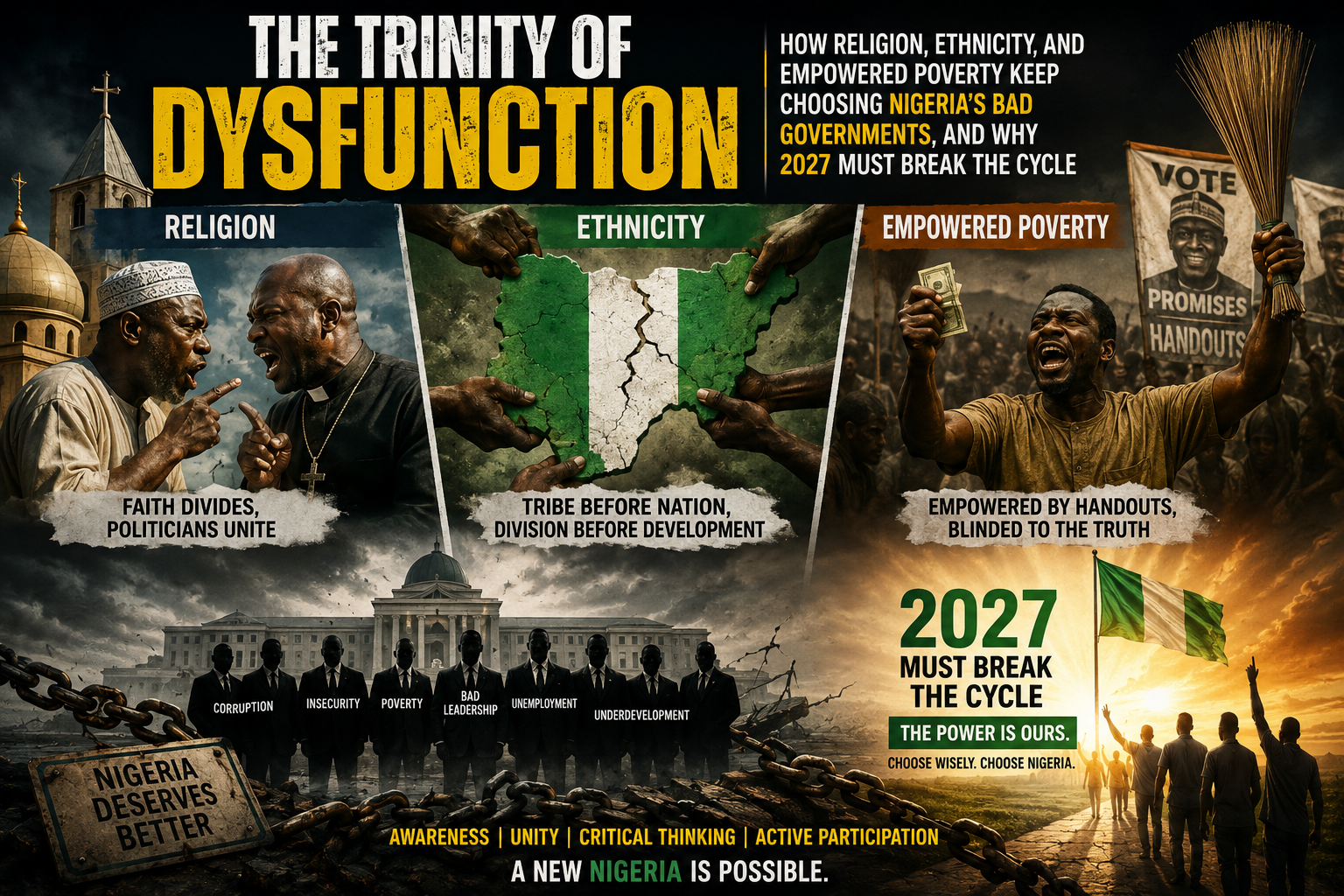
EXCLUSIVE: The Trinity of Dysfunction — How Religion, Ethnicity, and Empowered Poverty Keep Choosing Nigeria’s Bad Governments, and Why 2027 Must Break the Cycle
Nigeria’s democracy has matured in form but remains trapped in the substance of identity and survival. Every election cycle, from the Fourth Republic’s early contests through 2023 and into the looming 2027 general elections, the same forces reassert themselves: religion, ethnicity, and the politics of poverty.
These are not mere background noise. They are the primary drivers of electoral choice for large segments of the electorate.
The result is predictable—leaders selected for who they are rather than what they can do, governance that prioritizes patronage over performance, and a deepening cycle of underdevelopment that keeps the poor vulnerable to the next round of identity mobilization and cash inducements.
This is not abstract theory. Academic analyses of the 2023 presidential election, Afrobarometer data, SBM Intelligence surveys, and the work of historians such as Toyin Falola consistently show that ethno-religious affiliation continues to shape voting patterns more powerfully than policy platforms or track records.
Poverty does not merely coexist with this dynamic; it actively enables it by making short-term survival more rational than long-term accountability.
The outcome is bad governance that manufactures more poverty, which in turn entrenches the very voting behaviour that produced it.
Ahead of 2027, this trinity must be dethroned as the dominant yardstick.
Competence, character, and credible delivery must replace it — or Nigeria will simply recycle failure under new ethnic and religious banners.
Ethnicity: The Oldest Political Currency
Nigeria’s ethnic map still functions as an electoral map. The 2023 results illustrated this with clinical clarity: Bola Tinubu’s strongest support is in the South-West, Atiku Abubakar’s in the core North, and Peter Obi’s surge is concentrated in the South-East and among Christian communities elsewhere.
Studies of earlier cycles (2011, 2015, 2019) reveal the same regional-ethnic blocs, even when candidates shared religious or regional origins.
Elites understand this better than anyone. “Emi lokan” was not primarily a policy slogan; it was an ethnic claim. Similar appeals have long been deployed across regions.
As Falola and others have argued, ethnic loyalty often substitutes for performance evaluation.
Voters protect “their own” even when governance records are poor, because in a zero-sum system of scarce state resources, group access feels more secure than abstract national interest.
The consequence is mediocre leadership insulated by ethnic solidarity, appointments skewed toward co-ethnics, and national institutions hollowed out by the perception (and frequent reality) of sectional capture.
Religion: The Emotional Accelerator
Religion intensifies ethnicity. In a country where the North is predominantly Muslim and the South predominantly Christian (with significant overlaps and minorities), faith becomes a ready-made mobilization tool.
Political parties and candidates have repeatedly framed contests in existential religious terms—“our faith is under threat”—even when the underlying competition is about power and resources.
The 2023 Muslim-Muslim ticket debate and ongoing speculation about religious balance for 2027 show how quickly the conversation shifts from competence to demographic arithmetic.
Religious leaders and organizations often amplify this. Clerical endorsements and church/mosque mobilization turn pulpits into campaign platforms. Voters, fearing marginalization or worse, respond.
The irony is bitter: religion, which should demand moral accountability from leaders, is frequently instrumentalized to shield them from scrutiny.
As one Catholic Secretariat official recently urged, supporting a candidate solely because of shared faith does not guarantee delivery of the common good. Competence and integrity must come first.
Empowered Poverty: The Transaction That Undermines the Ballot
Poverty does not simply correlate with identity voting; it actively finances bad choices. Vote-buying and clientelism thrive where immediate cash or food offers more tangible value than distant promises of better roads, schools, or security.
Reports from recent off-cycle elections (Osun, Ekiti, and others) show inducements rising into the tens of thousands of naira per voter as inflation erodes purchasing power.
Analysts and surveys link this directly to material hardship: when households struggle with food insecurity, a day’s payment can outweigh four years of governance.
Some research nuances the picture—partisanship and ethnicity can be stronger predictors of targeting than pure poverty measures—yet the lived reality remains that economic vulnerability lowers the threshold for selling one’s vote.
Politicians understand the economics: keep people sufficiently poor and insecure, and the market for votes stays liquid.
The voter, rationally focused on survival, participates in the transaction that locks in the next cycle of underperformance.
This is “empowered poverty” in its purest form—poverty that actively shapes political outcomes rather than merely resulting from them.
The Vicious Cycle of Bad Governance
Select leaders primarily by tribe and faith, lubricate the process with cash, and the predictable product is governance oriented toward group patronage rather than national development.
Security appointments, contracts, and public resources tilt toward the winning coalition’s base.
Policy becomes secondary to maintaining the coalition. Inflation, insecurity, unemployment, and multidimensional poverty persist or worsen.
The next election arrives with the same impoverished, identity-primed electorate ready to be mobilized again.
Falola has repeatedly identified ethno-religious politics as Nigeria’s Achilles’ heel—eroding institutions, weakening accountability, and substituting primordial loyalty for merit.
SBM Intelligence and other monitors have documented how these factors drive turnout and preference more reliably than economic grievances in many contests.
Social media discourse, while often polarized, increasingly features voices insisting that 2027 must prioritize capacity over blood and belief.
The pattern is not destiny; it is a choice repeated under structural incentives that reward division.
Why These Yardsticks Must Be Abandoned in 2027
Continuing to use religion, ethnicity, and poverty-driven inducements as the primary filters will not produce different results.
It will only deepen mutual suspicion, raise the risk of post-election violence, and further delay the economic and institutional reforms Nigeria urgently needs.
Countries that have broken similar cycles did so by elevating performance metrics—growth, security, and service delivery—over identity arithmetic.
Nigerians already possess the tools: a large, youthful population increasingly exposed to alternative information; a diaspora that measures success by results rather than origin; civil society and faith institutions that can pivot from mobilization to accountability; and an electoral framework that, while imperfect, can be defended.
The Catholic Secretariat’s recent call, statements from politicians across parties, and growing online insistence on competence signal a possible shift. The question is whether enough voters will act on it.
The path forward is clear and unromantic. Demand detailed, costed policy platforms and past delivery records. Treat vote-buying as the self-sabotage it is.
Reject the framing of elections as existential contests between North and South or Christian and Muslim.
Insist that leaders of any background be judged by whether they expand opportunity, protect lives and property, and manage public resources with integrity.
Zoning and balancing arrangements may retain some transitional value, but they must not become substitutes for merit.
Nigeria’s problems — insecurity, macroeconomic instability, infrastructure deficits, human capital gaps — do not respect ethnic or religious boundaries. Solutions that do will continue to fail.
In 2027, the electorate has one overriding interest: selecting the people most capable of governing a complex, diverse, resource-rich but underperforming federation. Everything else is distraction.
The cost of repeating the old formula is already measured in lost decades and human potential. The cost of continuing it will be higher still.
 politics
 Adebayo Challenges Tinubu: Where Is Subsidy Money? Come Out and Account for It
 politics
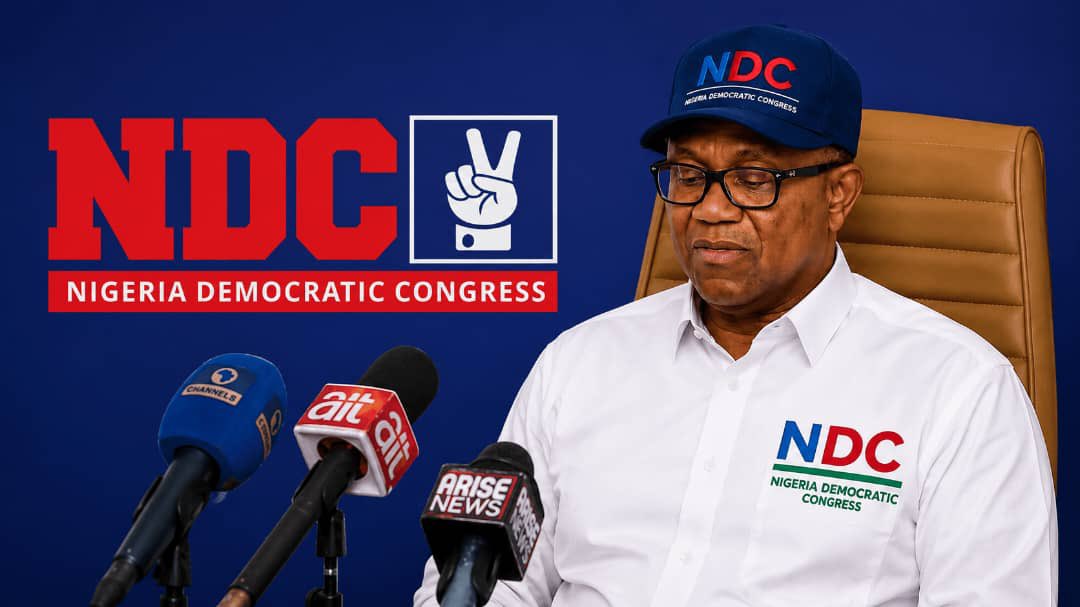
 NDC Wins Logo Battle as Abuja Court Orders INEC to Use Modified Design
 news
news Atiku Exposes Tinubu’s FAAC Scam: Bigger Naira, Poorer Nigerians
 news
news Police Arrest Hafsat Abubakar Over Fake Fintech Shutdown Document Circulated Online
 politics
 Sowore Declares Peter Obi Yelwata Blockade Government-Sponsored Political Attack
How do you feel about this news?
Community Additions
Have a news tip, correction, or extra context about this story? Post it below instantly. All submissions appear live on this screen immediately.