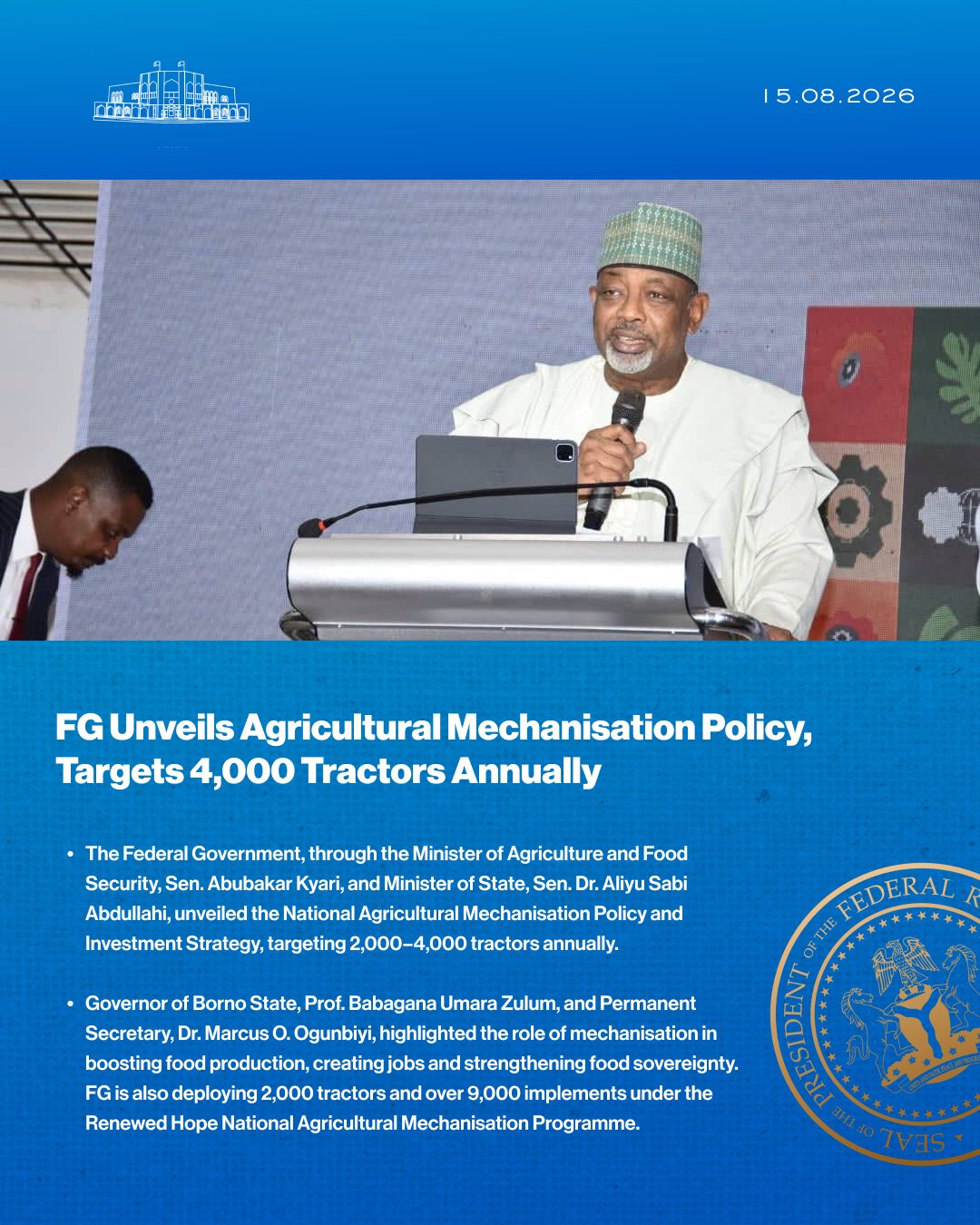
FG Unveils Agric Mechanisation Policy, Targets 4,000 Tractors Yearly for Food Sovereignty
Abuja, Nigeria – August 15, 2026 — The Federal Government has formally unveiled its National Agricultural Mechanization Policy and National Agricultural Mechanization Investment Strategy, setting an ambitious target of producing between 2,000 and 4,000 tractors annually through a new mega assembly plant.
The twin policy documents were presented on August 12 by the Minister of Agriculture and Food Security, Senator Abubakar Kyari, at a High-Level National Policy Dialogue on Agricultural Mechanization in Abuja.
The event, themed “Anchoring National Food Sovereignty through Sustainable Agricultural Mechanization Policy, Innovation, and Strategic Investment,” brought together federal and state officials, private-sector players, farmers’ groups, and development partners.
From Potential to Powerhouse
Kyari described the policies as a decisive shift from fragmented government tractor purchases to a commercially viable, private-sector-led mechanization ecosystem.
“It takes more than land, more than good intentions, to produce efficiently, competitively, and sustainably,” he said, outlining the goal of moving Nigeria “from agricultural potential to agricultural powerhouse; from mechanization deficit to mechanization leadership; and from food vulnerability to food sovereignty.”
Central to the investment strategy is the planned mega tractor assembly plant, designed to cut Nigeria’s heavy dependence on imported machinery, build local industrial capacity, and generate jobs.
The facility is expected to produce 2,000–4,000 units each year once operational.
Largest Mechanisation Push in Africa
Under the Renewed Hope National Agricultural Mechanization Programme (RH-NAMP), the government has already begun procuring and deploying 2,000 tractors together with more than 9,000 assorted implements and spare parts.
Officials call it the largest single agricultural mechanization programme ever undertaken on the African continent.
The tractors will be managed through Mechanization Service Providers rather than handed out as individual assets, with each unit expected to service roughly 600 hectares annually.
The model aims to reach more than 1.2 million farmers and cover over 1.5 million hectares each year.
Supporting infrastructure includes 36 mobile service trucks and seven mega mechanization service centres nationwide.
Mechanisation Beyond Tractors
Kyari stressed that true mechanisation covers the entire value chain—land preparation, planting, irrigation, crop protection, harvesting, processing, storage, logistics, and digital technologies.
The new approach centres on a “Mechanisation-as-a-service” economy so that farmers can access equipment when and where they need it at commercially sustainable costs.
A shared-responsibility framework assigns the Federal Government policy and standards roles, state governments land and infrastructure support, the private sector investment and service delivery, banks financing instruments, and development partners technical assistance.
Borno State Governor Prof. Babagana Umara Zulum and Permanent Secretary Dr. Marcus O. Ogunbiyi both highlighted the program’s potential to boost production, create jobs, and strengthen national food sovereignty.
The policy has been ratified and an implementation task force inaugurated to drive delivery.
As Nigeria seeks to feed a growing population and reduce food import bills, the success of this shift from hoes and cutlasses to modern, accessible machinery will be measured not by the number of tractors purchased, but by how productively and sustainably they reach the nation’s farmers.
 politics
 Adebayo Challenges Tinubu: Where Is Subsidy Money? Come Out and Account for It
 politics
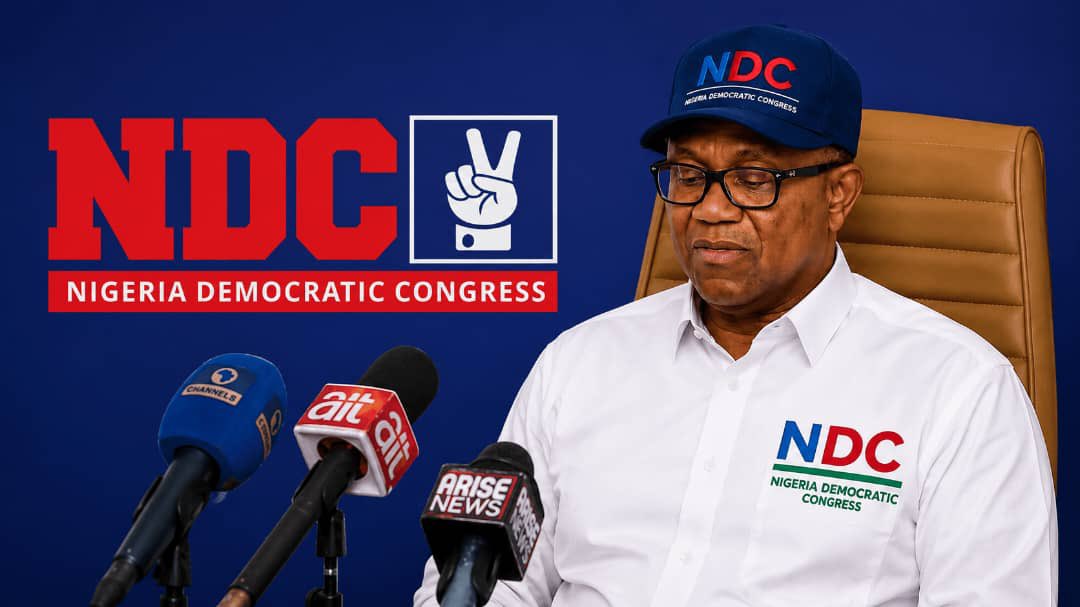
 NDC Wins Logo Battle as Abuja Court Orders INEC to Use Modified Design
 news
news Atiku Exposes Tinubu’s FAAC Scam: Bigger Naira, Poorer Nigerians
 news
news Police Arrest Hafsat Abubakar Over Fake Fintech Shutdown Document Circulated Online
 politics
 Sowore Declares Peter Obi Yelwata Blockade Government-Sponsored Political Attack
How do you feel about this news?
Community Additions
Have a news tip, correction, or extra context about this story? Post it below instantly. All submissions appear live on this screen immediately.