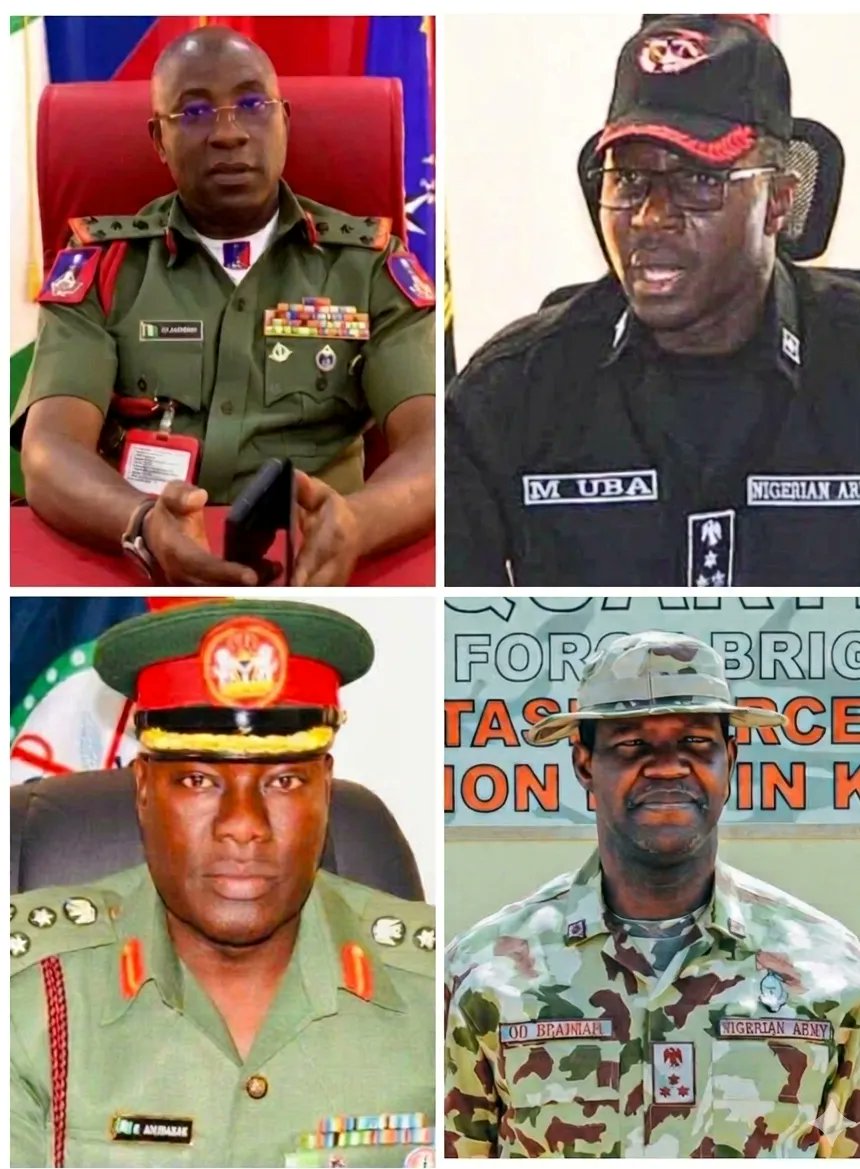
Four Generals Murdered, Tinubu’s Silence Is Criminal Negligence
The brutal killing of four Nigerian generals by terrorists and bandits under President Bola Tinubu’s watch is not just another tragic statistic in our endless insecurity saga.
It is a damning indictment of a government that has reduced the lives of its most senior military officers — and by extension, every ordinary citizen — to disposable pawns in a deadly game of political posturing and half-hearted responses.
In the last three years alone, high-ranking officers including Brigadier General Musa Uba, Brigadier General Oseni Omoh Braimah, Retired Major General Rabe Abubakar, and at least one other senior commander have been murdered or died in the custody of terrorists and bandits.
Their killers roam free. Not one has been credibly reported captured or neutralised in any meaningful operation tied directly to these atrocities.
The government’s silence in the face of these killings is not just alarming — it is a calculated indifference that reeks of a laissez-faire attitude toward the security of Nigerians.
This is not incompetence. This is a deliberate choice to play with lives. While the President issues occasional condolences and vague vows to “defeat terrorism,” the reality on the ground tells a different story.
Bandits and terrorists continue to abduct, execute, and humiliate even our most decorated officers with near-total impunity.
When a retired general like Rabe Abubakar can be snatched, held for weeks, and left to die in captivity — with his wife still in the hands of his killers — and the state responds with little more than statements and cosmetic operations, it sends a clear message: no one is truly safe, and no life, no matter how senior, truly matters enough to warrant decisive action.
The pattern is unmistakable and deeply insulting. These are not faceless soldiers in distant outposts.
These are generals — men who have commanded troops, shaped strategy, and served at the highest levels.
If the state cannot protect its own top brass from being hunted down like common prey, what hope does the ordinary farmer in Zamfara, the trader in Katsina, or the student in Borno have?
The government is effectively telling Nigerians that their lives are collateral in a conflict it has neither the will nor the competence to win.
This laissez-faire approach — the slow reactions, the recycled operations with new names but the same poor results, the reluctance to confront the political and economic underpinnings of banditry and terrorism — has turned Nigeria into a killing field where even the powerful are not spared. It is a betrayal of the social contract.
When a government treats the murder of its generals with the same casual detachment it shows toward mass killings of civilians, it reveals a profound contempt for the value of Nigerian life itself.
The silence is not accidental. It is a strategy of avoidance. Acknowledging the full scale of these failures would demand accountability, serious restructuring of the security architecture, and perhaps uncomfortable conversations about leadership.
Instead, we get press statements, occasional airstrikes that achieve little lasting impact, and a steady stream of bodies — both military and civilian — with no end in sight.
Nowhere is this dangerous complacency more evident than in the rising wave of mass kidnappings that have spread from the North into the Southwest in recent months.
In Ekiti State, gunmen stormed a Christ Apostolic Church in Eda-Oniyo community in April 2026, killed a visiting pastor, and abducted over 15 worshippers.
Weeks later, the victims remain in captivity despite ransom payments, with kidnappers now demanding even more money while the community protests in vain.
In Oyo State, on May 15, 2026, armed men raided several schools in the Ahoro Esinele area of Oriire Local Government, killing one teacher and abducting 39 students and seven teachers.
As of mid-June, many of these children and their teachers are still missing, with reports of ransom negotiations dragging on while families live in agony.
These are not isolated incidents. They represent a deliberate expansion of the kidnapping economy into regions once considered relatively safe.
Yet while parents in Ekiti and Oyo weep for their children and communities in the Southwest are forced to fortify their borders, the federal government appears far more preoccupied with 2027 electoral calculations than with mounting a serious, coordinated response.
The same administration that finds time and energy for political realignments and power consolidation seems paralysed when it comes to protecting the most basic right of Nigerians — the right to live without fear of being snatched from their homes, schools, or places of worship.
This is how a government plays with the lives of its citizens. It prioritises political survival over human security.
It issues empty threats to terrorists while negotiating or looking the other way when ransom demands are met.
It allows bandits and kidnappers to operate as parallel authorities in large swathes of the country, collecting “taxes,” imposing levies, and deciding who lives or dies.
The killing of generals and the abduction of schoolchildren are two sides of the same coin: a state that has surrendered its monopoly on violence and now treats the resulting chaos as an unfortunate but manageable cost of doing politics.
Nigerians deserve better than a commander-in-chief who appears more interested in managing perceptions and securing a second term than in securing lives.
The blood of these generals and the tears of kidnapped children in Ekiti, Oyo, and across the country cry out not just for justice against their tormentors, but for a complete rejection of the dangerous complacency that has allowed this carnage to continue.
Until that happens, every Nigerian — from the highest general to the lowest citizen — remains a potential target in a war the government seems content to manage rather than win.
 politics
 Adebayo Challenges Tinubu: Where Is Subsidy Money? Come Out and Account for It
 politics
 NDC Wins Logo Battle as Abuja Court Orders INEC to Use Modified Design
 news
news Atiku Exposes Tinubu’s FAAC Scam: Bigger Naira, Poorer Nigerians
 news
news Police Arrest Hafsat Abubakar Over Fake Fintech Shutdown Document Circulated Online
 politics
 Sowore Declares Peter Obi Yelwata Blockade Government-Sponsored Political Attack
How do you feel about this news?
Community Additions
Have a news tip, correction, or extra context about this story? Post it below instantly. All submissions appear live on this screen immediately.